MAY
The end of the month and I’m feeling every sort of weary
this morning – My head aches and a heavy numbness somethings/My something as if
of hemlock I had drunk – Keats? I think
so – anyway you get the idea. Cycling
through Cambridge on my way here, everywhere I look there are variations on a
theme of grey. On Midsummer Common, the
set-up for this year’s strawberry fair looks unsurprisingly desultory in the
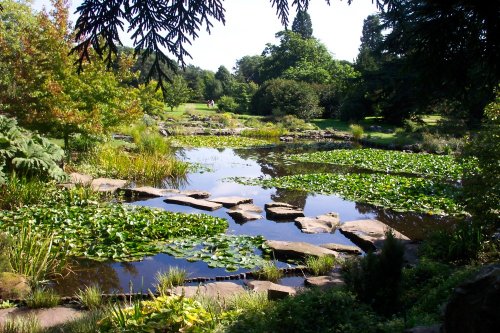
persistent drizzle, the paths slippery with mud. Walking in to the Botanics through the
Brookside gate, though, the prevailing impression shifts instantly, infinite
subtleties of shade and intensity which have the air around me glowing
green. This has a knock-on effect on
other colours, I notice: the tissue paper yellow and orange of the poppies
(Welsh poppies, we used to call them in Cumbria – I wonder if this is
accurate?) back-lit now, the delicate mauve of bluebells and early iris similarly
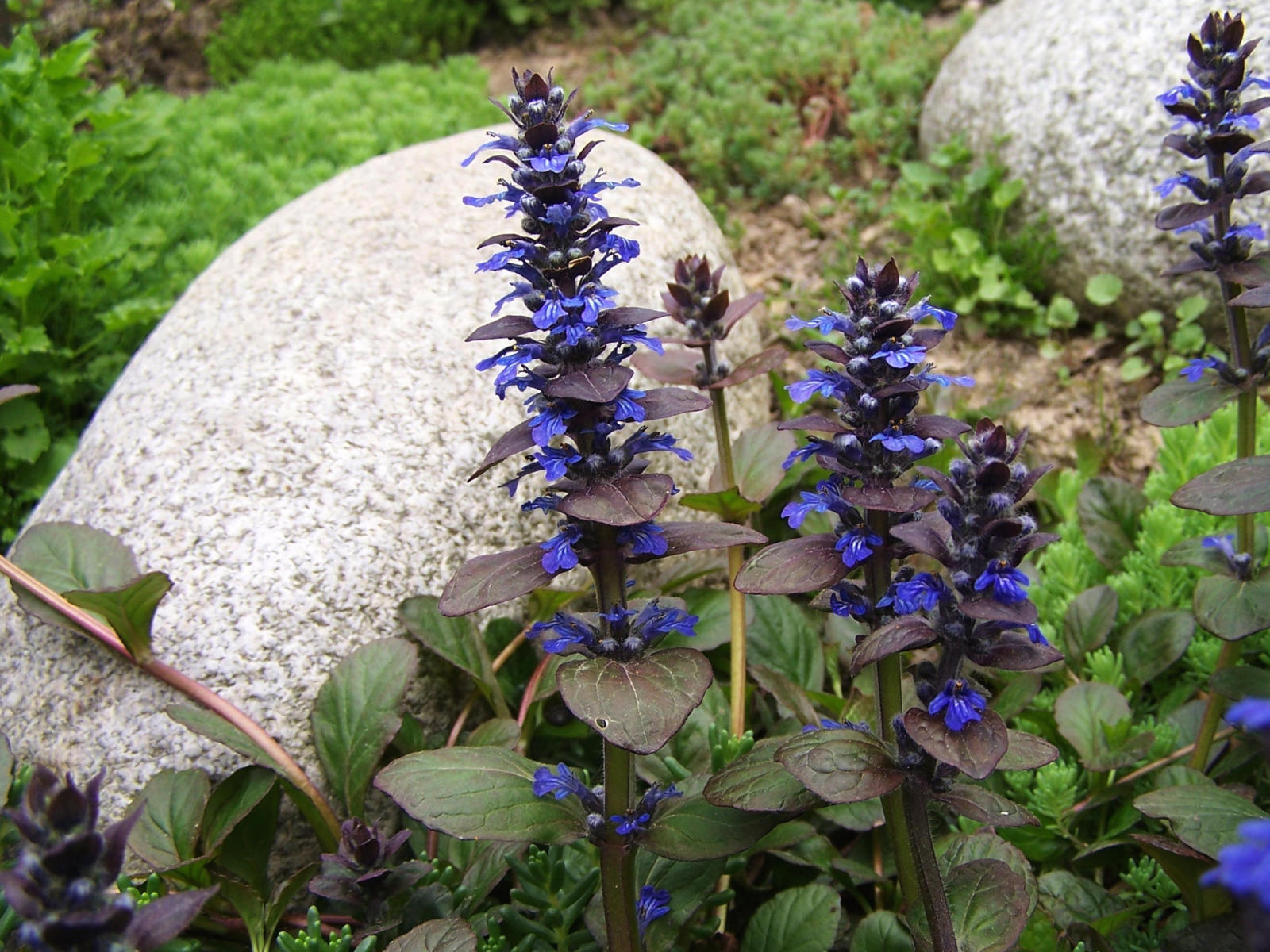
heightened, whilst the strongest colours – the purple of my new friend ajuga reptans (thanks to Tim for the
inspired tip: try sounding out their name in a Glaswegian accent for maximum
effect)and the vibrant pink of the peonies – are deepened. This injection of colour doesn’t lift my
spirits exactly, but it does soothe.
It’s OK to be sad on days like this, the dripping leaves reassure; stick
with it; let the dampness seep through the pores of your skin so that you
become part of it.
 |
| Photo courtesy of Galen Burrell |
New plant for today: paeonia
ludlowii Ludlow’s Tree Peony, its cupped flowers ‘bright golden-yellow’
according to the RHS.
JUNE (1)
Twelve days later, I look back at the last notes. I had forgotten the gloom though not the
peony, its name recurring this weekend when we visited Cambridge Garden
Plants. The name of the nursery belies
its nature, I think –accurate up to a point (location, merchandise) but nothing
about its title prepares me for the real thing, even though I’ve been half a
dozen times. You turn off the road into
a field of long grass; this is the car park.
Through a gap in the trees you are absorbed into a kind of alternative
reality, a world away from the scented candles and frocks and shoes (why?) of
the now ubiquitous ‘garden centre’, and also from the manicured lawns and neat
beds so prized when I was a suburban child.
I’ve just enjoyed Episode Three of Twigs Way’s marvellous sequence of talks on
the Tudor garden, which we learn was essentially a display of nature regulated and improved by
man; here in Horningsea Nature reigns, or seems to. Look left towards the house, where wisteria
and roses sprawl and clamber up and over the walls and each other. In the bed opposite the front of the house, a
hybrid musk rose ‘Buff Beauty’ towers above us.
The man who is CGP (why have we never learnt his name?) talks about the
nature of such roses before striking off round the corner into his own garden,
still explaining, linking, elucidating as we scamper along behind, towards
another beauty, a rugosa rose ‘Roseriae de L’Hay’. Its blowsy deep pink flowers and heady
fragrance are familiar to me from the bushes which line a small stretch of the
Norfolk Coast Path near Brancaster. It’s
easy enough to find an internet record of its origins: created in 1901 by Jules
Gravereaux, the cultivar was named for his garden in L’Hay, which now contains
more than 13.000 rose bushes and over 3000 species and
 |
| Photo courtesy of Paul Barden Roses |
varieties – imagine! Here, on a Sunday afternoon just outside
Cambridge, we find one example of this lovely rose for sale, in a pot amongst
the weeds by one of the sheds. Miranda
snaps it up. During our visit (getting
on for two hours, I should think) we retrace our steps along walkways between
stands of aquilegia and rue and geranium, past overgrown beds and perennials
originally for sale, presumably, now long grown through their Styrofoam trays
into the ground beneath, in and out of the poly-tunnel and repeatedly round the
garden in his wake. It seems to grow in
size with each circuit – here’s a pond new to all of us – and this feels like
an apt reflection of The Man’s encyclopaedic knowledge. I wonder if he has somewhere a written record
– I wish I’d asked. Because this double
treasury – in his memory and in the earth – is of course ephemeral. I’m wondering how and why this matters.
Our final trek takes us to a yellow tree peony – yes ludlowii, I echo, pleased to demonstrate
something other than my usual ignorance.
In the car on the way home, Andy tells me what he knows about Ludlow and
I beef this up later: Frank Ludlow was born in 1885, an officer, traveller,
naturalist and educator. He was the
first English man to enter Bhutan, collected almost 7000 bird specimens and
gave his name to (amongst others) a bird, a butterfly and a subspecies of
hedgehog as well as this sturdy peony.
He has a daunting list of publications and I think must be responsible
for a significant contribution to existing taxonomies; a record-maker, then, as
well as a record-keeper. He died in 1972
when I was 21. Three years later, one HR
Fletcher published A Quest for Flowers:
the plant explorations of Frank Ludlow and George Sherriff told from their
diaries and other occasional writings. I
add it to my list.
Eventually, more or less exhausted, we settle up: ‘call that
£4’, The Man says of my modest box of three.
He disappears into an outhouse for a plastic label and a pencil and
writes the name of the delicately-veined geranium I’ve found – Laurence Flatman
– ‘Flatman’ he repeats and goes over his pencil lettering, evidently no
confidence in my ability to remember – ‘cin. sub – that’s for cinereum,’ he explains. It’s a cranesbill, I discover later. He’s pleased that I can name the valerian I
have spent ten minutes digging out of its Styrofoam nest, though. My third is a foxglove, maybe pink but I have
my doubts.
JUNE (2)
Warm sunshine at last and suddenly there are foxgloves
everywhere, springing up beneath the magnolias, in amongst the aliums and
geraniums and delicate miniature iris in the bee beds. My favourites are papery white with a deep
crimson splash inside their cups, thinning to a splatter
 |
| Photo courtesy of Sarah Raven |
at the edge. I love the way their straight backs stretch
into a quietly dipped neck, self-contained, unassuming, though their Latin name
relates them to fingers rather than spines.
The etymology of the common name is both complex and fascinating, as is
the foxglove’s history as medicine and poison, sometimes both at once: its ‘oculotoxic’
effects, for example (blurred vision and a ‘halo’ effect round each point of
light) point apparently to the artist’s use of digitalis therapy in Van Gogh’s
‘Starry Night’.
I’m no painter and I shy away
from taking my own photos: although my tremor is so slight it often goes
unnoticed, most pictures I take are frustratingly blurred, but I’m not sure the
words by themselves are enough. I think
about Ludlow and his diaries, and about Darwin’s notebooks and papers so
compellingly translated into poems by his descendant Ruth Padel. I don’t know yet what shape or form the
record of my garden journey is going to take, but here’s food for thought: this
morning a thick envelope lands on my mat; inside, a soft paperback entitled
‘Garden Museum Journal Summer 2013’. Wrapped
around the outside is a paper band about three inches in depth, with coloured
numbers and the outlines of shapes which might be rocks. Inside the cover is a key: they are rocks; in
fact, this is the planting plan which Dan Pearson made for a
rockery when he was thirteen. The Summer Journal accompanies
the Garden Museum’s exhibition of Pearson’s work, and is a transcript of an
interview where Pearson describes how and why he became a garden designer,
intercut with extracts from his unpublished diaries and letters. The museum’s introduction to the journal ends
with its vision for the future, namely ‘to set up the country’s first archive
of garden design: to rescue existing records on paper and film, yes, but also
to capture memories which are precious, ephemeral and revealing’. It’s a lovely little booklet, and I’m excited
to receive something which seems to chime so soundly with what I’m about.
I go back to Keats (it was
Keats, of course) and find the original which I’d remembered so inaccurately:
My heart aches, and a drowsy numbness pains
My sense, as though of hemlock I had drunk...
 |
| Photo courtesy of Amberley House Cottages |
It’s from Ode to a Nightingale, as I’m sure most will
know. And there’s another memory I might
have been in danger of losing: a magical evening early last summer when Andy
led five of us through the woods by Grafham Water in search of the bird and its
astonishing repertoire, apparently in the region of 150 phrases before a
repeat. We wandered, trudged,
backtracked, tiptoed, lost all hope; and then we heard it ‘pouring forth’ its
‘soul’; magic indeed. Thanks, then, to all those whose pictures, and words, I’ve
borrowed in the interests of keeping the memories safe.