Tuesday, 18 June 2013

Garden Notes: May-June

MAY

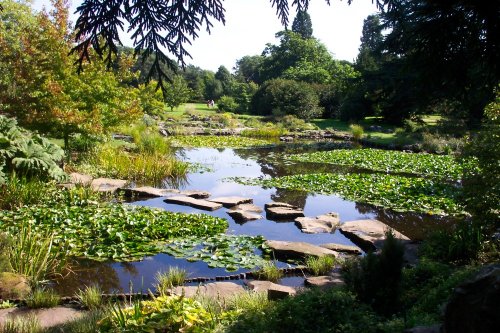
The end of the month and I’m feeling every sort of weary this morning – My head aches and a heavy numbness somethings/My something as if of hemlock I had drunk – Keats?  I think so – anyway you get the idea.  Cycling through Cambridge on my way here, everywhere I look there are variations on a theme of grey.  On Midsummer Common, the set-up for this year’s strawberry fair looks unsurprisingly desultory in the persistent drizzle, the paths slippery with mud.  Walking in to the Botanics through the Brookside gate, though, the prevailing impression shifts instantly, infinite subtleties of shade and intensity which have the air around me glowing green.  This has a knock-on effect on other colours, I notice: the tissue paper yellow and orange of the poppies (Welsh poppies, we used to call them in Cumbria – I wonder if this is accurate?) back-lit now, the delicate mauve of bluebells and early iris similarly heightened, whilst the strongest colours – the purple of my new friend ajuga reptans (thanks to Tim for the inspired tip: try sounding out their name in a Glaswegian accent for maximum effect)and the vibrant pink of the peonies – are deepened.  This injection of colour doesn’t lift my spirits exactly, but it does soothe.  It’s OK to be sad on days like this, the dripping leaves reassure; stick with it; let the dampness seep through the pores of your skin so that you become part of it.

Photo courtesy of Galen Burrell
New plant for today: paeonia ludlowii Ludlow’s Tree Peony, its cupped flowers ‘bright golden-yellow’ according to the RHS.


JUNE (1)

Twelve days later, I look back at the last notes.  I had forgotten the gloom though not the peony, its name recurring this weekend when we visited Cambridge Garden Plants.  The name of the nursery belies its nature, I think –accurate up to a point (location, merchandise) but nothing about its title prepares me for the real thing, even though I’ve been half a dozen times.  You turn off the road into a field of long grass; this is the car park.  Through a gap in the trees you are absorbed into a kind of alternative reality, a world away from the scented candles and frocks and shoes (why?) of the now ubiquitous ‘garden centre’, and also from the manicured lawns and neat beds so prized when I was a suburban child.  I’ve just enjoyed Episode Three of Twigs Way’s marvellous sequence of talks on the Tudor garden, which we learn was essentially a display of nature regulated and improved by man; here in Horningsea Nature reigns, or seems to.  Look left towards the house, where wisteria and roses sprawl and clamber up and over the walls and each other.  In the bed opposite the front of the house, a hybrid musk rose ‘Buff Beauty’ towers above us.  The man who is CGP (why have we never learnt his name?) talks about the nature of such roses before striking off round the corner into his own garden, still explaining, linking, elucidating as we scamper along behind, towards another beauty, a rugosa rose ‘Roseriae de L’Hay’.  Its blowsy deep pink flowers and heady fragrance are familiar to me from the bushes which line a small stretch of the Norfolk Coast Path near Brancaster.  It’s easy enough to find an internet record of its origins: created in 1901 by Jules Gravereaux, the cultivar was named for his garden in L’Hay, which now contains more than 13.000 rose bushes and over 3000 species and
Photo courtesy of Paul Barden Roses
varieties – imagine!
  Here, on a Sunday afternoon just outside Cambridge, we find one example of this lovely rose for sale, in a pot amongst the weeds by one of the sheds.  Miranda snaps it up.  During our visit (getting on for two hours, I should think) we retrace our steps along walkways between stands of aquilegia and rue and geranium, past overgrown beds and perennials originally for sale, presumably, now long grown through their Styrofoam trays into the ground beneath, in and out of the poly-tunnel and repeatedly round the garden in his wake.  It seems to grow in size with each circuit – here’s a pond new to all of us – and this feels like an apt reflection of The Man’s encyclopaedic knowledge.  I wonder if he has somewhere a written record – I wish I’d asked.  Because this double treasury – in his memory and in the earth – is of course ephemeral.  I’m wondering how and why this matters.

Our final trek takes us to a yellow tree peony – yes ludlowii, I echo, pleased to demonstrate something other than my usual ignorance.  In the car on the way home, Andy tells me what he knows about Ludlow and I beef this up later: Frank Ludlow was born in 1885, an officer, traveller, naturalist and educator.  He was the first English man to enter Bhutan, collected almost 7000 bird specimens and gave his name to (amongst others) a bird, a butterfly and a subspecies of hedgehog as well as this sturdy peony.  He has a daunting list of publications and I think must be responsible for a significant contribution to existing taxonomies; a record-maker, then, as well as a record-keeper.  He died in 1972 when I was 21.  Three years later, one HR Fletcher published A Quest for Flowers: the plant explorations of Frank Ludlow and George Sherriff told from their diaries and other occasional writings.  I add it to my list.

Eventually, more or less exhausted, we settle up: ‘call that £4’, The Man says of my modest box of three.  He disappears into an outhouse for a plastic label and a pencil and writes the name of the delicately-veined geranium I’ve found – Laurence Flatman – ‘Flatman’ he repeats and goes over his pencil lettering, evidently no confidence in my ability to remember – ‘cin. sub – that’s for cinereum,’ he explains.  It’s a cranesbill, I discover later.  He’s pleased that I can name the valerian I have spent ten minutes digging out of its Styrofoam nest, though.  My third is a foxglove, maybe pink but I have my doubts.


JUNE (2)

Warm sunshine at last and suddenly there are foxgloves everywhere, springing up beneath the magnolias, in amongst the aliums and geraniums and delicate miniature iris in the bee beds.  My favourites are papery white with a deep crimson splash inside their cups, thinning to a splatter
Photo courtesy of  Sarah Raven
at the edge.  I love the way their straight backs stretch into a quietly dipped neck, self-contained, unassuming, though their Latin name relates them to fingers rather than spines.  The etymology of the common name is both complex and fascinating, as is the foxglove’s history as medicine and poison, sometimes both at once: its ‘oculotoxic’ effects, for example (blurred vision and a ‘halo’ effect round each point of light) point apparently to the artist’s use of digitalis therapy in Van Gogh’s ‘Starry Night’. 
  
I’m no painter and I shy away from taking my own photos: although my tremor is so slight it often goes unnoticed, most pictures I take are frustratingly blurred, but I’m not sure the words by themselves are enough.  I think about Ludlow and his diaries, and about Darwin’s notebooks and papers so compellingly translated into poems by his descendant Ruth Padel.  I don’t know yet what shape or form the record of my garden journey is going to take, but here’s food for thought: this morning a thick envelope lands on my mat; inside, a soft paperback entitled ‘Garden Museum Journal Summer 2013’.  Wrapped around the outside is a paper band about three inches in depth, with coloured numbers and the outlines of shapes which might be rocks.  Inside the cover is a key: they are rocks; in fact, this is the planting plan which Dan Pearson made for a rockery when he was thirteen.  The Summer Journal accompanies the Garden Museum’s exhibition of Pearson’s work, and is a transcript of an interview where Pearson describes how and why he became a garden designer, intercut with extracts from his unpublished diaries and letters.  The museum’s introduction to the journal ends with its vision for the future, namely ‘to set up the country’s first archive of garden design: to rescue existing records on paper and film, yes, but also to capture memories which are precious, ephemeral and revealing’.  It’s a lovely little booklet, and I’m excited to receive something which seems to chime so soundly with what I’m about.   

I go back to Keats (it was Keats, of course) and find the original which I’d remembered so inaccurately:

My heart aches, and a drowsy numbness pains
My sense, as though of hemlock I had drunk...
Photo courtesy of Amberley House Cottages

It’s from Ode to a Nightingale, as I’m sure most will know.  And there’s another memory I might have been in danger of losing: a magical evening early last summer when Andy led five of us through the woods by Grafham Water in search of the bird and its astonishing repertoire, apparently in the region of 150 phrases before a repeat.  We wandered, trudged, backtracked, tiptoed, lost all hope; and then we heard it ‘pouring forth’ its ‘soul’; magic indeed.  Thanks, then, to all those whose pictures, and words, I’ve borrowed in the interests of keeping the memories safe.

Thursday, 23 May 2013

Testing the water


Ten days into a year as Writer in Residence* at the ‘Botanics’ and I’ve dipped in a toe or two: a few pencil notes in the pretty ‘journal’ I bought along with a small plant in the garden shop on Day One, a couple of talks on the Tudor garden by Twigs Way (really), and some hours spent recording stories for the Voicing the Garden project on Saturday.  Time now for a real dip – or a good paddle at least.


The Oxford English Dictionary defines residence as ‘a person’s home, especially a large and impressive one’ and the Cambridge University Botanic Garden is certainly that, so that I’m feeling overawed rather by the expanses of lawn and bed and woodland as well as by the size of the task: what have I taken on?!  I suppose there is an echo of the official residence, too, in the fact that I am here in some sort of professional capacity.  I think of the phrase ‘taken up residence’ as I creep rather self-consciously in through the Station Road gate this morning – will those who ‘really’ work here think I don’t have a home to go to?  The dictionary gives the origin of the word as late Middle English (denoting the fact of living in a place) from Old French, or from medieval Latin residentia, from Latin residere 'remain'.  I like this: for now, for the next eleven and a half months in fact, I’m staying here, doing my best to make myself at home.
The weather’s not very welcoming, cold and grey and not quite raining but a robin fluffed up against the mean wind shouts out my arrival.  I am excited that I am able to guess the bird from the song.  For years I have loved the sound of birdsong, often waking at first light to the rich pleasures of the dawn chorus.  But I have never managed to identify more than the obvious pigeons and gulls from the way they sing.  I have a similar block when it comes to tango music, years of pleasurable listening leaving me not much further forward when it comes to recognising a particular orchestra.  I think being resident here will help me learn to observe, to tune in to the sights and sounds around me, to practise new ways of listening.

Valerian
I have been reading Derek Jarman’s Smiling in Slow Motion, immersed in his writing each morning on the bus to and from Addenbrookes as I approach the end of a course of radio therapy.  I think of a recent tango lesson, the teacher describing the final stage of the ocho, the figure of eight, as the beginning of the next figure.  Jarman’s journal is an extraordinary record of, almost a meditiation on, his garden, his art and film work, his social and sex lives, his relatonship with his partner and his struggle with AIDS.  I find it funny, touching, shocking and tender by turns, but always absorbing.  I love the characters that move through the pages, the luvvies and the fluffers, Gingerbits and Sister Latex of the Immaculate Protection rubbing shoulders with Mrs Jekyll and John Gerard, his passion for colour, his fearless openness.  He has no time for our ‘national inability to describe our sex lives’, pronouncing it ‘pathetic’, and is equally scathing towards the way the National Trust ‘tarts up’ its properties and the way Gay Times (‘on the fringes of intelligence’) settles for the ‘false hope’ of the positive image: life was ‘not The Sound of Music; if you climbed a mountain it was a sweaty affair and you might not reach the summit'.   His fury at the way society has marginalised ‘queers’ such as himself is matched by his many passions: for colour, for the strange landscapes of Dungeness and above all for his garden.  In March, he describes it ‘putting on the colours of spring, the inky purple Crambe maritime uncurl like medieval capitals, sap-green elder, pale-blue rosemary flowers, garlic racing with the iris, crocus punctuate purple and yellow’; in June, he watches cabbage whites ‘dance’ in the magenta valerian and watches a poppy open: ‘Opium poppies  shed their petals as you blink, their dusty colours almost a little sad, dreamy, contrasted with their scarlet cousins and the harlequinade of their Californian relatives’. 

I am in equal parts excited by the world of lovely plants which I am about to discover and embarrassed by my ignorance: but I remind myself that the expertise on which this garden has been created has come in part from learning by observation and enquiry; ‘that was how Darwin learnt, after all,’ Hilary Sutton said speaking about her work as a volunteer with school visits here.  And the garden now welcomes everyone, so it seems fitting that at least for some of my time here I’m happy to sit in the cafe with my laptop and let the human aspect ebb and flow around me.  The notion of expertise is a strange one.   Chatting to Sarah last night over cocktails (Caipirinha a delicious first for me) in a belated birthday celebration, she spoke about a book she was reading which identified three stages in the art of photography: the first where you are faced with an array of techniques and information and simply try to keep up; the second where confidence arrives suddenly, and you accumulate skills and expertise with apparent ease; the third, when you throw out the lot and start again from scratch.  The model certainly holds good for the process – it is a process – of Argentine tango; I have a feeling it might apply equally to this residency, and more generally to the whole life thing where, as for tango, I am clearly at that starting again stage.  As for being – becoming – a botanic gardens writer in residence, the beginning of the beginning...

‘So what does it actually entail?’ almost everyone asks when they hear about this latest venture.  The question reduces me to an extreme version of my usual incoherent vagueness.  The honest answer is I don’t know.  It’s an exploration and for once I’m going to try and be brave enough to manage without maps.  In any case, this has never been done before.   Of course there have been other residencies; there may even have been a writer, or writers, in residence at the Cambridge gardens previously; but not me.  This combination – the Botanics and me – is a new and unique enterprise which I am hoping might help me to join up some of the dots: my interest in memory, in routes to health and well-being, in the natural world.  Fact or fiction?  Um – somewhere between the two?  How best to document what is unfolding in the world around me, to capture the rhythms of the seasons?  As well as learning to look and listen, I find myself reading voraciously, growing a list of garden notes and writer’s diaries and logs of personal journeys.  Who knows where my journey will lead?

Planting myself in this corner of the café has already attracted some welcome attention.  Helen stops by, yellow plastic bucket in hand, on her way to – I think she is in charge of alpines – and we compare notes about Saturday’s recordings.  Then I am spotted by Anna the yoga teacher who introduces me to her friend Kat and we trade stories.  Anna is immensely excited by my new role and wants to put her name down for the first workshop!   I remind her I am still a new cutting: I need a bit of time to ‘take’.  Later a young man with an impressive array of notebooks joins me at the other end of the table.  Today there is a noisy influx of visitors – one group or several? – and the table I have claimed acquires a ‘reserved’ sign for later.  For now, though, I sit tight.  I have a fantasy that, if I sit here for long enough, some of the job might come to me, a bit like an MP’s surgery – I’m here for questions, referrals, advice, support. Perhaps the café staff will gather to create a series of cake haiku?  Or a bunch of beleaguered mums dump their noisy offspring for a quick injection of word play?


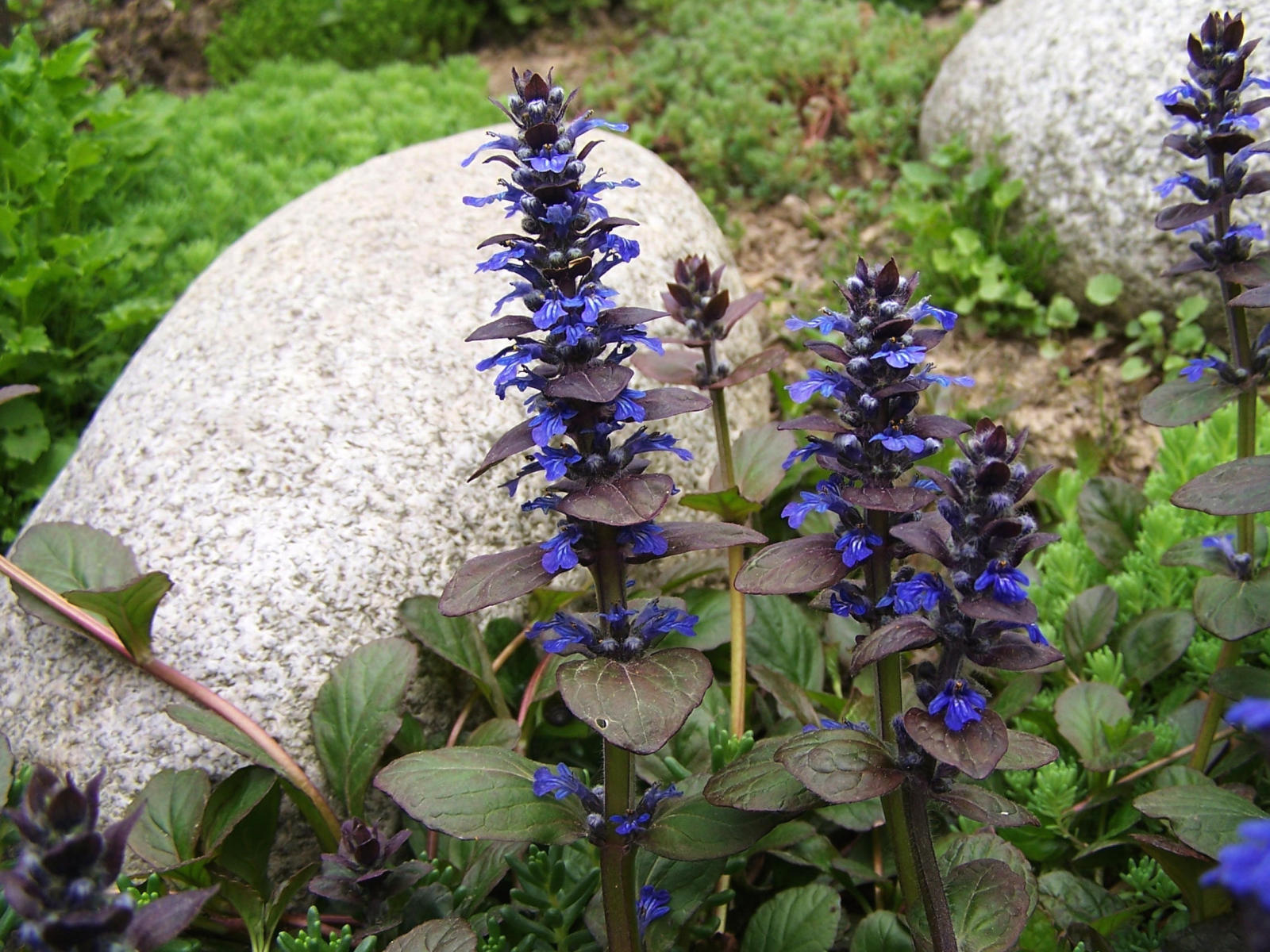
At the weekend I planted my new acquisition, ajuga reptans, under the small apple tree in my garden.  Its common name is bugle:           1. noun any of a genus (Ajuga) of plants of the mint family; especially : a European annual (A. reptans) that has spikes of blue flowers      2. noun a valveless brass instrument resembling a trumpet.  I remember the robin’s fanfare for my arrival this morning, and hope that bodes well.  

*with grateful thanks to Arts Council England